Project

Circulating light on any photonic platform.

CIRCULIGHT is a European research project focused on the development of compact, highly functional and energy-efficient photonic integrated circuits based on integrated optical circulators.

Mission

Aims of the CIRCULIGHT project

The CIRCULIGHT project aims to develop highly functional, miniaturized, and energy-efficient Photonics Integrated Circuits (PICs), which are also easy to manufacture and cost-effective.

The focus is on creating an integrated optical circulator, an essential component for the protection, distribution, and integration of optical functions in various PIC architectures. The key will be an approach based on magneto-optical nanoparticle-composite sol-gel material and on the Magneto-BiPlasmonic (MBP) effect, enabling the optical circulator to be integrated monolithically into any photonic platform.

Approach

Compact, High-Performance Circulator Design.

The circulator will be designed to achieve high mode asymmetry in the core, enabling high isolation ratios. The structure will be compact, with a footprint optimized for telecom integration. Performance will be tuned by adjusting gyrotropy, slot geometry, and material properties, ensuring reliable one-way light routing for practical photonic systems.

Demonstration of the Magneto Bi-Plasmonic Effect

The project aims to experimentally validate the Magneto-BiPlasmonic (MBP) effect, previously only shown in simulations. This involves generating strong mode asymmetry in plasmonic slot waveguides filled with MO material. The physical effect will be achieved by controlling nanoparticle properties, material magnetization, and waveguide geometry, enabling nonreciprocal light propagation essential for integrated optical circulators.

Theory

Operational Principle MBP Circulator.

Nonreciprocal light routing and MBP effect

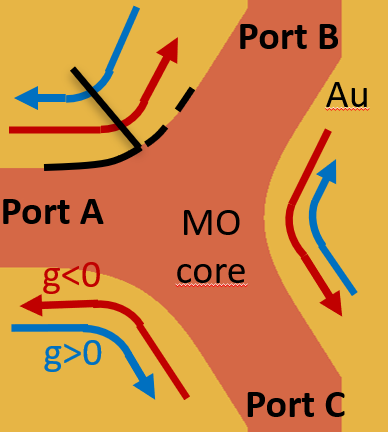
The optical circulator is a nonreciprocal 3-port device that routes light directionally: Port A → Port B, Port B → Port C, and Port C → Port A.

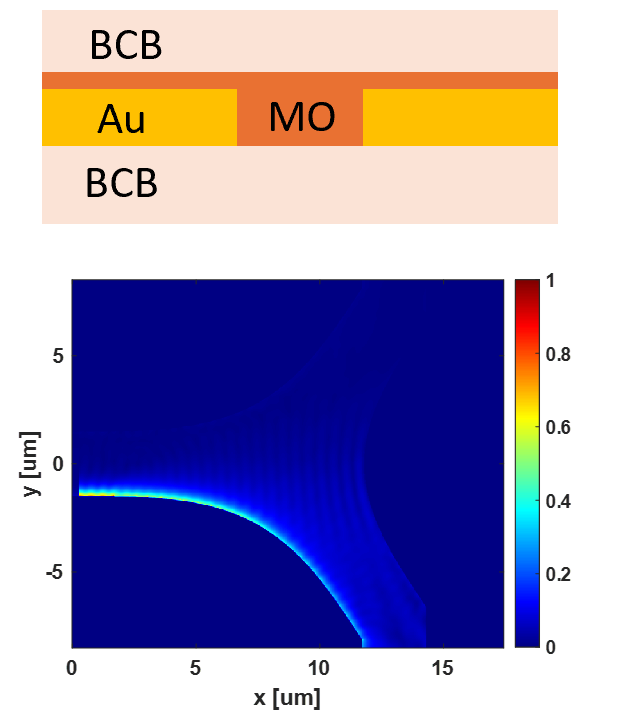
This design achieves nonreciprocity by perturbing plasmonic mode coupling through the Transverse Magneto-Optical Kerr Effect (TMOKE). The circulator core is filled with an MO sol-gel composite containing magnetic nanoparticles. Gold cladding forms a Metal-Insulator-Metal (MIM) slot waveguide supporting Long-Range Surface Plasmon Polaritons (LRSPPs).

Schematic principle of a 3-port optical circulator Magneto-biplasmonic circulator core
Materials

Magneto-Optical Sol-Gel Material Development

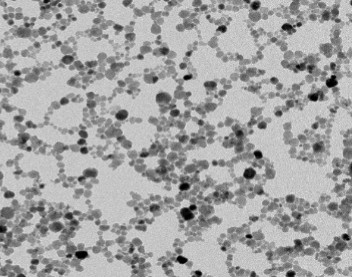
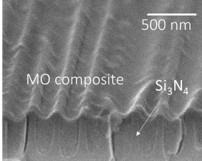
The circulator core is based on a novel magneto-optical (MO) sol-gel composite using sol-gel technology, allowing liquid-phase deposition and solidification independent of substrate properties. Embedded MO garnet or Co-Fe nanoparticles enable tunable magneto-optical response and refractive index.

Magneto-optical sol-gel material
Nanoparticle composite material

The material supports integration into narrow slits, is compatible with lithography, and maintains optical transparency at telecom wavelengths (1.3 μm and 1.5 μm).

Numerical desingn and modelling

Low-Loss Integration with Photonic Circuits.

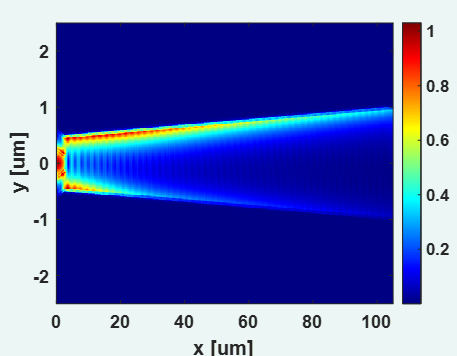
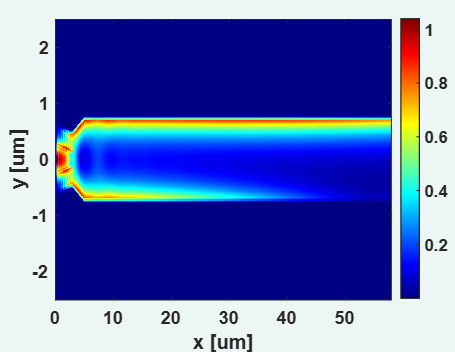
Efficient integration with photonic integrated circuits (PICs) is a core objective. The project develops tapered transitions between silicon waveguides and magneto-plasmonic slots, using both butt-joint and evanescent coupling. Simulations (FDTD/FEM) and optimization techniques will ensure minimal insertion loss and robust mode matching in the adiabatic (left) and tapered transition (right) with mode-beating principle of asymetrization.

Adiabatic coupler Tapered transition with mode-beating assymetrization principle
Integration

Monolithic Integration and Proof-of-Concept

To validate real-world functionality, the circulator will be monolithically integrated with a laser and a photodetector on two PIC platform. The system will support applications in sensing, data communication, and telecom. Polarization-independent operation will be addressed through polarization-diversity schemes. This proof-of-concept will demonstrate the circulator's feasibility for compact, low-power, high-performance optical systems.

Tapered transition with mode-beating assymetrization principle
Exploration

Societal Impact and Sustainability

We ensure that the CIRCULIGHT project is shaped by real-world needs through early and ongoing collaboration with a broad range of industrial and societal stakeholders.

Roadmap of the co-creation process

Together, we co-create a circulator technology roadmap, exploring use cases, and identify barriers and enablers for sustainable implementation of the circulator. As part of this process, we study how and when societal impact can be addressed in the development of enabling technologies, ensuring it is meaningfully embedded from the very beginning.

9 partners

Research institutions and industrial partners.

6 countries

European collaboration across the project consortium.

42 months

Project duration from 2024 to 2027.

101129645 grant agreement

Funded under Horizon Europe / EIC Pathfinder.

Project visual

Prepared space for the main project illustration.

This block is ready for a future diagram, experimental scheme, consortium image or visual explanation of the CIRCULIGHT concept.

Project visual placeholder